

Earwax (cerumen) is a natural, healthy substance produced by glands in the ear canal. It protects the delicate skin of the canal, traps dust and debris, and has antimicrobial properties that help prevent infection. For most people, earwax migrates out of the ear naturally, and no intervention is needed. But for some people, wax builds up faster than it can clear, or it gets pushed deeper into the canal by cotton swabs, earbuds, hearing aids, or other objects, leading to a blockage known as cerumen impaction.
At Vitality Family Health in Oak Brook, IL, we provide safe, in-office ear cleaning and earwax removal for both children and adults. The procedure is quick, gentle, and effective, and it is one of those visits where patients often walk out the door saying they feel better immediately. If you have been dealing with muffled hearing, ear fullness, discomfort, or the frustration of a blockage that will not resolve on its own, professional removal is the safest and most reliable solution.
Cerumen impaction occurs when earwax accumulates in the ear canal to the point where it partially or completely blocks the canal. This can happen gradually over weeks or months, and many people do not realize how much wax has built up until their hearing noticeably changes or they develop discomfort. Impaction is one of the most common ear-related reasons patients visit a primary care provider, affecting an estimated 6 percent of the general population and up to 57 percent of older adults in nursing facilities.
Several factors increase the likelihood of cerumen impaction. Narrow or unusually shaped ear canals make it harder for wax to migrate out naturally. Regular use of cotton swabs, bobby pins, or other objects pushed into the ear canal compacts wax deeper rather than removing it. Frequent use of earbuds, hearing aids, or earplugs can block the natural outward flow of wax. Older adults tend to produce drier, harder earwax that is more likely to accumulate. Certain skin conditions, such as eczema within the ear canal, can also increase wax production or alter its consistency.
Does one or both ears feel plugged, full, or like you are hearing through a wall?
Have you noticed a gradual decrease in hearing that seems to come and go?
Are your ears itching persistently, and nothing you do at home seems to help?
Do you use earbuds, hearing aids, or earplugs regularly and wonder if wax is building up?
Have you been using cotton swabs to clean your ears and suspect you may have pushed wax deeper?
Earwax impaction can cause a range of symptoms that vary from mildly annoying to significantly disruptive. The most common signs include a feeling of fullness or pressure in the ear, muffled or decreased hearing (often in one ear more than the other), tinnitus (ringing, buzzing, or humming in the ear), persistent itching in the ear canal, ear pain or a dull ache, dizziness or a sense of imbalance, and occasionally a cough triggered by stimulation of the vagus nerve in the ear canal.
In children, earwax buildup may show up as inattentiveness, difficulty following directions, pulling or tugging at the ear, or complaints of ear discomfort. Because these symptoms overlap with ear infections and other conditions, professional evaluation is important to determine the cause and provide the right treatment.
Cotton swabs (Q-tips) are the most common culprit behind impacted earwax. Despite their widespread use, cotton swabs do not effectively remove wax from the ear canal. Instead, they push existing wax deeper toward the eardrum, compact it into a harder mass, and can scratch or injure the delicate skin of the canal, increasing the risk of infection. In rare cases, a cotton swab inserted too deeply can perforate the eardrum, which is a serious and painful injury.
Ear candles, another popular home remedy, are both ineffective and dangerous. Studies have shown that ear candling does not create sufficient suction to remove wax and can cause burns, dripping hot wax into the ear canal, and even eardrum perforation. Medical organizations including the FDA advise against their use.
Over-the-counter earwax softening drops can be helpful for mild buildup in some cases, but they are not always sufficient for significant impaction and should not be used if you have a perforated eardrum, ear tubes, or an active ear infection. If home drops have not resolved your symptoms, or if you are unsure whether it is safe to use them, professional removal is the recommended next step.
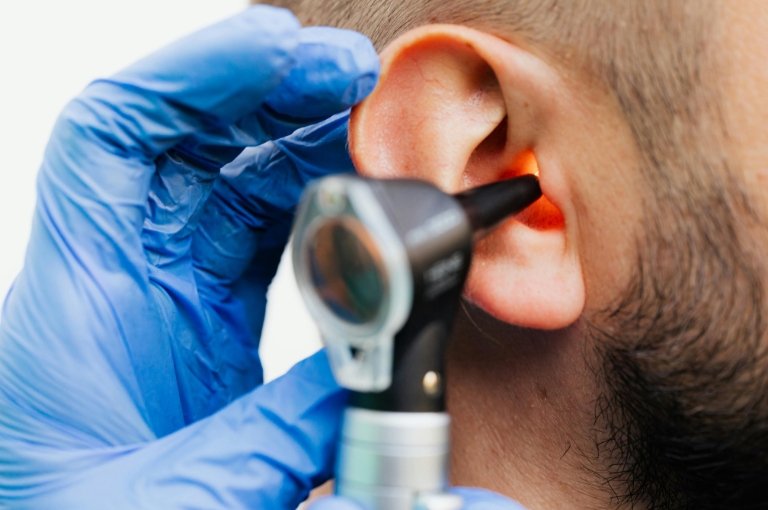
Before any removal, your provider uses an otoscope to look inside the ear canal and assess the amount, consistency, and location of the wax, as well as the health of the eardrum and surrounding structures. This allows us to choose the safest and most effective removal method for your specific situation and to rule out other conditions (such as infection or a foreign body) that may be causing your symptoms.
Ear irrigation uses a controlled stream of warm water mixed with hydrogen peroxide directed into the ear canal to flush out softened wax. This is one of the most commonly used methods for cerumen removal and is generally well tolerated. The water is warmed to body temperature to minimize dizziness, and the flow is carefully controlled to avoid excessive pressure. Irrigation is not used in patients with a known or suspected eardrum perforation, ear tubes, or a history of ear surgery.
For harder, more impacted wax, or in cases where irrigation is not appropriate, your provider may use a curette (a small, specialized instrument) to carefully remove wax under direct visualization. This method allows precise, controlled removal and is often the preferred technique for patients with narrow ear canals, a history of eardrum perforation, or ear tubes.
In some cases, we may use a combination of softening drops (applied at the visit or prescribed for use at home in the days before your appointment), followed by irrigation or manual removal. This combination approach is particularly effective for stubborn, hard, or deeply impacted wax.
Earwax removal is a quick, in-office procedure that typically takes 15 to 30 minutes, depending on the amount and consistency of the wax and the method used. Most patients experience immediate improvement in hearing and a noticeable reduction in ear fullness and discomfort. Some mild residual moisture, slight sensitivity, or temporary dizziness after irrigation is normal and resolves quickly.
After removal, your provider will examine the ear canal again to confirm the wax has been fully cleared and to check the health of the eardrum. We provide aftercare guidance, including how to prevent future buildup and when to return if symptoms recur. For patients who are prone to recurrent impaction, we may recommend periodic in-office cleanings on a schedule that keeps the problem from recurring.
Professional ear cleaning is a safe, routine procedure when performed by a trained provider. However, certain ear symptoms require prompt medical evaluation beyond a standard cleaning. Contact our office or seek medical attention if you experience sudden, significant hearing loss in one or both ears, severe ear pain, drainage of fluid, pus, or blood from the ear, high fever accompanied by ear pain (especially in children), a foreign object lodged in the ear canal, dizziness or vertigo that does not resolve, or hearing loss after a head injury.
Do not attempt to remove impacted earwax at home using cotton swabs, bobby pins, car keys, or any other object inserted into the ear canal. Do not use ear candles. These methods can cause injury, infection, and eardrum damage. If you are unsure whether your symptoms are related to earwax or something else, contact our office and we will help you determine the appropriate next step.
If you are experiencing muffled hearing, ear fullness, persistent itching, tinnitus, ear pain, or dizziness, earwax buildup may be the cause. If over-the-counter drops have not resolved the issue, or if you are unsure whether your symptoms are from wax or another condition, a professional evaluation is the safest way to find out. We can look in the ear canal, identify the problem, and treat it on the spot.
Most patients find the procedure comfortable or only mildly uncomfortable. Irrigation with warm water may feel unusual but is generally well tolerated. Manual removal may cause brief pressure or mild discomfort, but it is not painful for most people. For children or anxious patients, we take a gentle, patient approach and explain every step of the process.
Most people do not need routine professional ear cleaning. The ears are self-cleaning for the majority of the population. However, if you are prone to recurrent wax buildup due to narrow ear canals, frequent earbud or hearing aid use, dry wax production, or other factors, periodic in-office cleanings (every 6 to 12 months, for example) can prevent impaction from developing. Your provider will recommend a schedule based on your individual situation.
No. Cotton swabs should not be inserted into the ear canal. They push wax deeper, compact it against the eardrum, and can scratch or injure the canal or perforate the eardrum. The outer portion of the ear (the pinna and the very entrance to the canal) can be gently wiped with a washcloth after showering, but nothing should be inserted into the canal itself.
Yes. Earwax buildup is common in children and can affect hearing, behavior, and school performance. We provide gentle, age-appropriate ear cleaning for pediatric patients. If your child is complaining of ear discomfort, seems to have difficulty hearing, or is pulling at their ears, we can evaluate whether wax buildup, an ear infection, or another condition is the cause.
Ear candles are not effective and are not safe. They do not create enough suction to remove earwax, and they carry real risks including burns, hot wax dripping into the ear canal, and eardrum perforation. The FDA has issued warnings against their use, and we do not recommend them.
Yes. Cerumen impaction is one of the most common reversible causes of hearing loss, particularly in older adults. When wax fully or partially blocks the ear canal, sound waves cannot reach the eardrum efficiently, resulting in muffled or decreased hearing. Once the wax is removed, hearing typically returns to normal immediately. If hearing does not improve after removal, further evaluation may be recommended to rule out other causes.
Ear cleaning services are available to members of our practice. If you are not currently a member, we invite you to schedule a discovery consult to learn about our membership model and the full range of primary care services we offer.
The discovery consult is a brief, no-cost conversation where you can share your needs, ask questions, and find out whether Vitality Family Health is the right fit. If we are a good match, we will walk you through the next steps to become a member. There is no pressure and no obligation.
You may also want to read about Annual Well Checkups, Well Woman Exams, Hormone Imbalances, Thyroid Imbalances, Gut Health, Heart Health, Minor Wound Care, and Dermabond, since ear cleaning is one of the many in-office services we provide as part of comprehensive primary care.
Medically Reviewed By: Dr Kori Feldman, M.D.
Vitality Family Health & Wellness Partners is located in Oak Brook, Illinois, and serves patients throughout the Greater Chicagoland Area and the entire state of Illinois. These areas include but are not limited to the downtown Chicago area, surrounding suburbs, central, northern, and southern Illinois, and southern Wisconsin and Northwest Indiana.